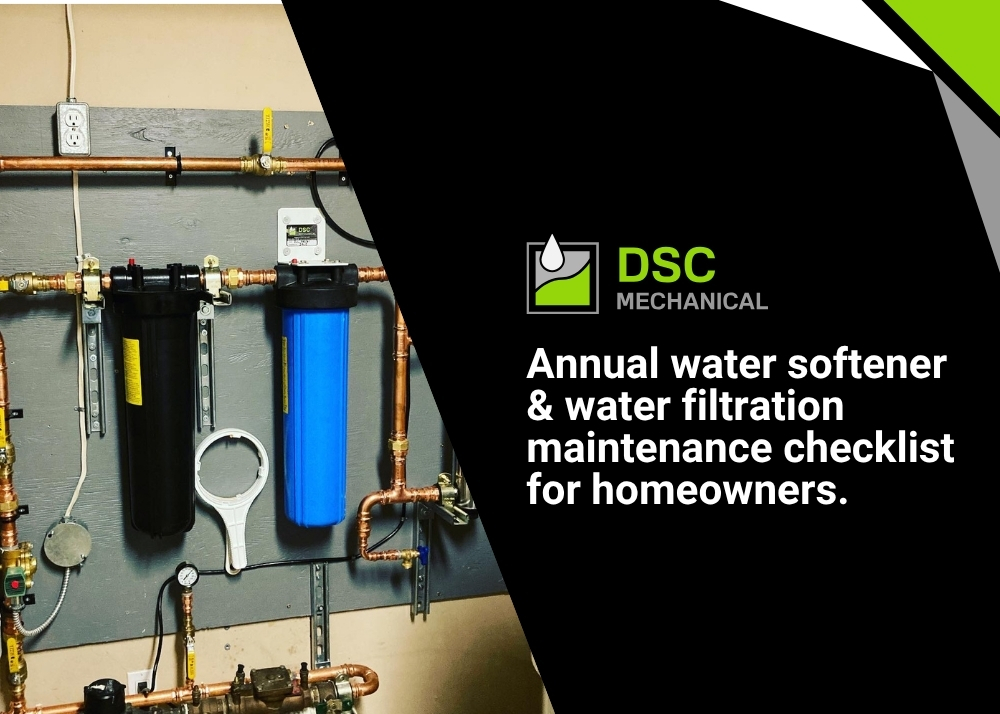
Annual water softener and water filtration maintenance checklist for homeowners.
A water softener or whole-home filtration system can provide reliable water treatment for years, but like any mechanical system, it needs regular maintenance to perform properly.
Homeowners often remember to add salt to a water softener but overlook other important maintenance tasks, such as checking for salt bridges, replacing sediment filters, cleaning iron buildup from resin, or changing UV lamps.
A little routine maintenance can help protect your equipment, maintain water quality, reduce the risk of unexpected problems, and extend the life of your water treatment system.
If you own a water softener, reverse osmosis system, UV water disinfection system, or whole-home filtration equipment, this annual water softener and filtration maintenance checklist can help you keep everything operating properly.
Why regular water treatment maintenance matters
Water treatment equipment operates every day, often without homeowners giving it much thought.
Your water softener continuously removes hardness minerals from incoming water. Filtration systems remove sediment and other contaminants, while UV systems disinfect water as it passes through the treatment chamber.
Over time, components can become dirty, depleted, or less effective.
A water softener with a salt bridge may not regenerate properly. Iron can accumulate on softener resin and reduce treatment performance. A clogged sediment filter can restrict water flow, while an old UV lamp may no longer provide the level of disinfection your system was designed to deliver.
Routine maintenance helps identify these problems before they become larger issues.
Water softener maintenance checklist
1. Check your salt level regularly
Checking the salt level is one of the simplest and most important water softener maintenance tasks.
The brine tank needs an adequate supply of salt for the regeneration process. If the salt level becomes too low, the softener may eventually stop removing hardness effectively.
However, constantly filling the tank to the top isn't necessarily the best approach.
Follow the manufacturer's recommended salt level and check the tank regularly. The exact amount and type of salt recommended can vary depending on the softener.
If you notice that your salt consumption has suddenly changed, your water has become harder, or the system appears to be regenerating differently, it may be time to have the system inspected.
2. Check for a salt bridge
A salt bridge is a hardened layer of salt that forms inside the brine tank.
It can look like there is plenty of salt in the tank even though the salt underneath the bridge has been depleted.
This prevents the salt from dissolving properly and can interfere with the regeneration process.
To check for a salt bridge, gently press down on the salt with an appropriate tool or handle. If the salt appears solid and doesn't give way as expected, a bridge may have formed.
Don't use excessive force or damage the brine tank while attempting to break it apart.
Once the bridge has been safely broken up, check the system to make sure it is operating normally.
If salt bridging continues to happen frequently, there may be an underlying issue with moisture, salt quality, system operation, or the brine tank itself.
3. Clean the brine tank when necessary
Over time, sediment, salt residue, and other buildup can accumulate inside the brine tank.
A brine tank does not necessarily need to be completely cleaned every year, but it should be inspected periodically and cleaned when buildup becomes excessive or when recommended by the equipment manufacturer.
Before cleaning, always follow the manufacturer's instructions for your specific system.
If you're unsure how to safely clean the tank, professional service can help prevent damage to the equipment and ensure it is returned to proper operation.
4. Check for iron buildup on the softener resin
Iron can be a significant water treatment concern for private well owners throughout Manitoba and Northwestern Ontario.
While a water softener can sometimes handle certain levels of iron, excessive iron can accumulate on the resin inside the softener and interfere with its ability to remove hardness.
A resin cleaner designed for water softening systems can help remove accumulated iron and restore resin performance when appropriate.
The correct cleaning schedule depends on the iron concentration in your water and the type of equipment installed.
If your water contains significant iron, simply adding more salt may not solve the problem. The system may require a dedicated iron removal solution or other treatment before the water reaches the softener.
5. Replace sediment pre-filters
If your water treatment system uses a sediment pre-filter, inspect it regularly and replace it according to the manufacturer's recommendations.
Sediment filters capture particles such as sand, dirt, rust, and other suspended material before water reaches downstream treatment equipment.
As the filter becomes clogged, water flow can decrease and the system may have to work harder to deliver the required flow.
For homes supplied by private wells, filter replacement frequency can vary significantly depending on the amount of sediment entering the water.
If you notice reduced water pressure or visibly dirty filter media, don't wait for the scheduled replacement date. The filter may need to be changed sooner.
6. Replace your UV lamp annually
UV water disinfection systems require particular attention because the lamp can lose effectiveness over time even when it still appears to be working.
A UV lamp should generally be replaced according to the manufacturer's recommended schedule, commonly once every 12 months.
The lamp may still produce visible light after a year, but that doesn't necessarily mean it is providing the same disinfection performance.
The quartz sleeve surrounding the lamp should also be inspected and cleaned as recommended. Mineral deposits or other buildup on the sleeve can reduce the amount of UV light reaching the water.
If your home relies on UV treatment for bacterial disinfection, staying on schedule with lamp replacement is especially important.
7. Check your water filters and RO system
Reverse osmosis systems have multiple filter stages that require periodic replacement.
Sediment filters and carbon filters eventually become exhausted and need to be changed. The RO membrane also has a longer service life but should be replaced when its performance declines or according to the manufacturer's recommendations.
Signs that an RO system may require maintenance include slower water production, changes in taste or odor, reduced water quality, or unusual system cycling.
Because different RO systems use different filter configurations, always follow the manufacturer's recommended replacement schedule.
8. Inspect for leaks
During your annual maintenance check, inspect the water treatment equipment and surrounding plumbing for leaks.
Look around the water softener, brine tank, filter housings, connections, valves, tubing, and drain lines.
Even a small leak can eventually cause water damage if it goes unnoticed.
If you find water around the equipment, shut off the appropriate water supply if necessary and have the system inspected rather than assuming the leak will resolve itself.
9. Check your water quality
Maintenance shouldn't only focus on the equipment itself.
Pay attention to changes in your water.
Have you noticed more scale on faucets? Is there a change in taste or odor? Are you seeing orange or brown staining? Has your water pressure changed?
Changes in water quality can sometimes indicate that equipment needs maintenance, but they can also indicate a change in the source water itself.
This is particularly important for properties using private wells, cottages, and rural water systems.
If something about your water has changed, consider having the water tested before replacing equipment or making adjustments.
Annual water treatment maintenance schedule
A simple annual routine can help keep your system on track.
Monthly: Check the water softener salt level, look for salt bridging, inspect equipment for visible leaks, and pay attention to changes in water quality or pressure.
Every few months: Inspect sediment filters, check the brine tank for buildup, and review system operation and regeneration.
Annually: Replace UV lamps where applicable, inspect or replace filtration cartridges according to manufacturer recommendations, assess softener resin condition, and have the system professionally inspected if required.
As needed: Break up salt bridges, clean the brine tank, use an appropriate resin cleaner for iron buildup, replace clogged filters, and address leaks or changes in water quality.
Your specific maintenance schedule should always follow the requirements of your equipment and water conditions.
When should you call a water treatment professional?
Routine maintenance is something many homeowners can handle, but there are situations where professional service is the better option.
If your water softener isn't regenerating, your water remains hard despite the system operating, iron staining has returned, water pressure has dropped, the system is leaking, or your water quality has changed significantly, there may be a problem that basic maintenance won't resolve.
This is especially true for private well systems.
Water quality can change over time, and the treatment equipment that worked well when it was first installed may eventually require adjustment, additional filtration, or replacement.
A professional water treatment technician can test the water, inspect the equipment, identify the cause of the problem, and determine whether maintenance or a different treatment solution is required.
Why Manitoba and Northwestern Ontario homeowners need to stay on top of maintenance
Water conditions can vary significantly throughout Winnipeg, Southern Manitoba, Northern Manitoba, and Northwestern Ontario.
Homes and cottages using private wells can encounter hard water, iron, sulfur, sediment, tannins, bacteria, and other water quality concerns. Seasonal changes can also affect groundwater and surface water conditions.
That means there isn't one maintenance schedule that works perfectly for every property.
A water softener in a Winnipeg home connected to municipal water may have very different maintenance requirements than a cottage using a private well in Northwestern Ontario.
Understanding your water source and keeping your equipment properly maintained are both important parts of an effective water treatment strategy.
Keep your water treatment system working properly
A water softener or filtration system is an investment in your home's water quality, plumbing, appliances, and everyday comfort.
Regularly checking salt levels, breaking up salt bridges, cleaning the brine tank when necessary, addressing iron buildup, replacing sediment filters, maintaining RO filters, and changing UV lamps on schedule can help keep your system operating as intended.
However, maintenance can't always solve an underlying water quality or equipment problem.
If your water treatment system isn't performing as expected, DSC Mechanical can help.
DSC Mechanical provides water treatment installation, maintenance, and service for residential, cottage, commercial, and municipal customers throughout Winnipeg, Southern Manitoba, Northern Manitoba, and parts of Northwestern Ontario. Their services include water softeners, filtration systems, reverse osmosis, UV disinfection, iron and sulfur removal, and other customized water treatment solutions.
If you're unsure whether your water softener or filtration system is due for maintenance, contact DSC Mechanical to arrange professional service and make sure your equipment is ready to keep treating your water properly

Contact Us
Box 4439
Stonewall, Manitoba, Canada, R0C 2Z0
x 204-404-7019 A info [at] dscmechanical [dot] com
