Are store-bought water softeners worth it? Professional installation vs big box units.
If you've been shopping for a water softener, you've probably noticed that there are plenty of systems available from large retail stores and online marketplaces. At first glance, buying a packaged water softener and arranging your own installation can seem like an easy way to save money.
But there is an important question to ask before choosing a system based on the sticker price:
Is the unit actually the right water softener for your home and water conditions?
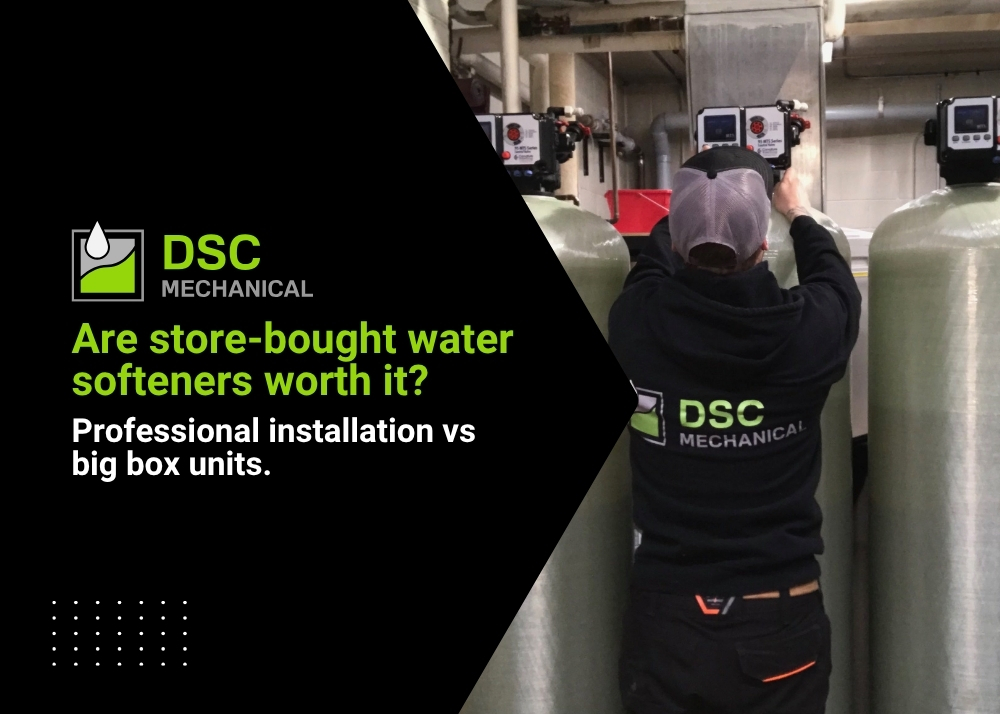
The difference between a store-bought water softener and a professionally selected and installed system isn't necessarily that one is automatically good and the other is bad. The bigger difference is often in how the equipment is selected, sized, installed, configured, and supported after the sale.
For homeowners in Winnipeg, Southern Manitoba, Northern Manitoba, and Northwestern Ontario, those factors can make a significant difference because water hardness, well conditions, household demand, and available water flow can vary considerably from one property to another.
Store-bought water softeners can be a reasonable option for some homeowners, particularly when the property has straightforward plumbing, predictable water quality, and the homeowner understands how to select and maintain the equipment.
The problem is that many buyers focus primarily on the price of the equipment rather than whether the system is correctly matched to their home.
A water softener is not a one-size-fits-all appliance.
The system needs to be capable of handling the amount of water your household uses, the hardness level of the water, the available flow rate, and the regeneration demands of the property.
A cheaper unit that is incorrectly sized may ultimately cost more through inefficient operation, premature wear, poor water quality, or service issues.
Water softener sizing is more important than many homeowners realize
One of the biggest differences between purchasing a water softener off the shelf and having one professionally selected is sizing.
Water softeners are commonly rated according to their grain capacity. This represents the amount of hardness the system can remove before it needs to regenerate.
But simply choosing the system with the highest grain capacity isn't necessarily the right approach.
The correct size depends on factors such as household water consumption, water hardness, the number of people in the home, peak water demand, and the characteristics of the water source.
A system that is too small may regenerate more frequently than necessary, increasing salt and water consumption and potentially reducing its useful life.
A system that is unnecessarily large can also operate inefficiently and cost more than required.
Professional water treatment starts with understanding the actual water conditions and usage requirements rather than choosing a unit based solely on a product label.
Grain capacity doesn't tell the whole story
When comparing water softeners, it can be tempting to look at the grain capacity and assume that the system with the higher number is automatically better.
It isn't that simple.
The advertised capacity of a softener needs to be considered alongside the amount of resin in the tank, the efficiency of the regeneration process, the hardness of the incoming water, and how the control valve manages regeneration.
Two systems with similar advertised capacities can perform differently depending on their design and programming.
This is why comparing water softeners based on grain capacity alone can be misleading.
The goal isn't to buy the biggest system. It's to select a system that provides the appropriate treatment capacity for your property while operating efficiently.
The control valve makes a difference
The control valve is one of the most important components of a water softener.
It controls how water moves through the system, when the softener regenerates, how the resin is cleaned, and how the system manages water and salt usage.
A quality control valve can provide greater control over regeneration, flow management, programming, and system operation.
The valve also plays an important role in long-term serviceability. If a component eventually requires maintenance or replacement, having access to serviceable parts and knowledgeable technicians can make a major difference.
When comparing a professionally installed system with an off-the-shelf unit, don't just compare the tank size or advertised grain capacity. Ask what type of control valve the system uses and how it will be serviced if something goes wrong.
Your home's water flow rate matters
Another factor that can easily be overlooked when purchasing a water softener is water flow.
A softener needs to accommodate the water demand of your home without creating an unnecessary restriction.
Imagine someone taking a shower while the washing machine is running and another household member starts a faucet. Your water treatment system needs to handle that demand while continuing to provide adequate flow.
This becomes especially important for larger homes, families with higher water usage, commercial properties, and homes supplied by private wells.
A professional installer can evaluate the property's available water flow, pump capacity, plumbing configuration, and expected demand before selecting equipment.
That information can be just as important as the hardness level when determining what system is appropriate.
Well water can make water softener selection more complicated
Homes connected to municipal water aren't the only properties that use water softeners.
Many rural Manitoba and Northwestern Ontario properties rely on private wells, and well water can present additional treatment challenges.
Hardness may be accompanied by iron, manganese, tannins, sulfur, sediment, or other water quality issues.
A standard water softener isn't designed to solve every water quality problem.
For example, elevated iron can interfere with softener resin and reduce system performance. Depending on the water chemistry, a dedicated iron removal system or other pre-treatment may be necessary before the water reaches the softener.
This is one of the reasons DSC Mechanical recommends testing the water before selecting treatment equipment. Their free water testing process collects information about the water source, pump, hardness, iron, manganese, turbidity, pH, total dissolved solids, tannins, chlorides, and sulfates, with additional laboratory testing available where required.
Professional installation is about more than connecting pipes
A water softener needs to be correctly integrated into your home's plumbing system.
Installation can involve the main water supply, bypass connections, drain lines, brine tanks, programming, and other plumbing components.
The system also needs to be positioned appropriately and configured according to the property's water conditions.
An installation that technically gets water flowing through the softener isn't necessarily an installation that optimizes the system's performance.
Proper installation helps reduce the risk of leaks, drainage problems, incorrect regeneration settings, poor water flow, and other issues that can affect the equipment over time.
What about warranty and service?
Warranty coverage is another area homeowners should investigate before purchasing a water softener.
A product warranty and actual service support are not necessarily the same thing.
Before buying a system, consider who will service it if the control valve fails, the system stops regenerating, the resin needs attention, or a component needs to be replaced.
Also ask what is covered under the manufacturer's warranty and whether installation requirements apply.
A professionally supplied system gives homeowners a local point of contact for installation, maintenance, troubleshooting, and repairs.
For a piece of equipment that's connected directly to your home's plumbing and expected to operate for years, that ongoing support can be just as important as the initial purchase price.
Comparing upfront cost with long-term value
A store-bought water softener may have a lower initial equipment cost, particularly if you're comfortable handling some of the installation yourself.
However, the lowest purchase price doesn't necessarily represent the lowest total cost over the life of the system.
Consider the full picture.
You need to account for the equipment, installation or plumbing modifications, programming, salt and water efficiency, maintenance, replacement parts, potential repairs, and the expected lifespan of the system.
A professionally selected system may cost more initially but can provide better value if it is properly sized, efficiently programmed, supported locally, and maintained throughout its service life.
The right question isn't simply, "Which water softener is cheapest?"
It's:
"Which system is properly matched to my water, my home, and my long-term needs?"
When a store-bought water softener may make sense
A retail water softener isn't automatically a bad choice.
If you have a good understanding of your water quality, know your household's water demand, have suitable plumbing, understand the system's specifications, and are comfortable handling installation and future maintenance, a retail system may work well.
The important thing is to make an informed decision rather than assuming that a larger grain capacity or lower purchase price means better value.
When professional water softener installation makes more sense
Professional installation becomes particularly valuable when your water quality is complicated, your home relies on a private well, your property has high water demand, or you're unsure how to size the equipment.
It can also make sense when you want one company responsible for selecting, installing, servicing, and maintaining the system.
For homeowners who don't want to spend time diagnosing water treatment problems themselves, professional installation provides another important benefit: accountability.
You have someone who understands the system and the conditions it was designed for.
Why local water treatment experience matters
Water conditions aren't identical across Manitoba and Northwestern Ontario.
Water profiles can vary significantly between Winnipeg, Stonewall, the Interlake, rural Southern Manitoba, Northern Manitoba, and Northwestern Ontario.
This is particularly important for private well owners, where water chemistry can vary considerably between neighbouring properties.
DSC Mechanical is based in Stonewall, Manitoba, and provides water treatment services throughout Winnipeg, Southern and Northern Manitoba, and Northwestern Ontario. The company works with residential, cottage, commercial, and municipal customers and has more than 20 years of combined experience, including a Red Seal Plumber on its team.
Their approach focuses on understanding the property's water conditions before recommending equipment, rather than simply selling a particular unit.
Get your water tested before you buy a softener
If you're considering purchasing a water softener, don't start with the equipment catalogue.
Start with your water.
DSC Mechanical provides free water testing to help identify the characteristics of your water and determine what type of treatment your property actually needs. Their team can then recommend equipment based on water chemistry, source, flow requirements, and household or property usage.
Whether you're in Winnipeg, Southern Manitoba, Northern Manitoba, or Northwestern Ontario, professional testing can help prevent the common mistake of purchasing a system that isn't properly matched to your property.
Is professional water softener installation worth it?
For some homeowners, a store-bought water softener may be perfectly adequate.
For others, especially those with private wells, challenging water chemistry, larger households, or more complex plumbing systems, professional selection and installation can provide considerably more value over the life of the system.
The biggest advantage isn't simply having someone install the equipment.
It's having the right system selected, correctly sized, properly installed, configured for your water, and supported after installation.
If you're considering a water softener, DSC Mechanical can help you determine what your property actually needs before you spend money on equipment.
Contact DSC Mechanical to arrange your free water test and get a professional recommendation for your home, cottage, business, or property.

Contact Us
Box 4439
Stonewall, Manitoba, Canada, R0C 2Z0
x 204-404-7019 A info [at] dscmechanical [dot] com
