Why one-size-fits-all water softeners fail in Manitoba.
Hard water is a common concern for homeowners across Manitoba. White scale on faucets, spots on dishes, residue in showers, and buildup inside water-using appliances can all be signs that hard water minerals are affecting your home. A water softener can help address these problems, but choosing the right system involves more than purchasing a unit and connecting it to your plumbing.
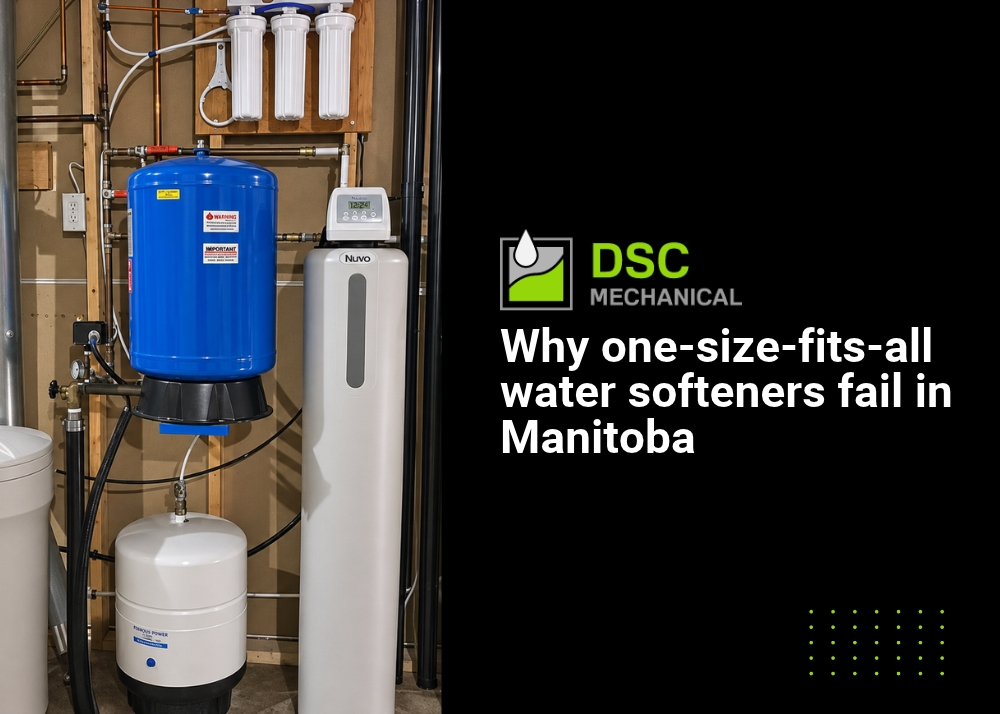
One of the biggest mistakes homeowners make is assuming that every property needs the same type of water softener. In reality, water quality, household demand, plumbing configurations, and other factors can vary significantly from one property to another. A system that works well in one home may not deliver the same results in another.
This is particularly important in Manitoba, where water conditions can differ between municipal supplies and private wells. Some properties primarily deal with hardness, while others may also experience iron, manganese, sediment, or other water quality concerns that a standard softener is not designed to address.
At DSC Mechanical, we help homeowners, cottage owners, and businesses throughout Winnipeg, Southern and Northern Manitoba, and Northwestern Ontario understand their water quality and choose treatment systems suited to their specific needs.
Manitoba water isn't the same everywhere
It's easy to assume that water quality is relatively consistent throughout the province, but the source of your water can make a significant difference to the treatment your property needs.
Homes connected to municipal water supplies have different considerations than rural properties that rely on private wells. Even among well owners, water chemistry can vary depending on the location and characteristics of the water source. Two neighbouring properties may experience different combinations of hardness, iron, manganese, tannins, and other characteristics.
These differences matter because a water softener is designed primarily to reduce hardness minerals, particularly calcium and magnesium. Although some softeners can also remove certain amounts of iron under appropriate conditions, they are not a universal solution for every water quality issue.
For example, a homeowner experiencing white scale on showerheads and fixtures may benefit from a properly selected softener. However, someone dealing with reddish-brown staining, black deposits, or a rotten egg smell may need additional treatment designed specifically for iron, manganese, or sulfur-related problems.
Installing a softener without understanding the water first can leave some of these concerns unresolved. That's why water treatment should begin with identifying the problem rather than assuming the same equipment will work for every property.
The problem with choosing the wrong size
Even when a water softener is the right type of system, choosing the wrong capacity can affect its performance.
A softener needs enough capacity to handle the hardness entering the property and the amount of water being used. A household with several occupants and frequent water use may have different requirements from a smaller household or seasonal cottage. The hardness level also affects how quickly the system's treatment capacity is used.
If a system is undersized for the property's demand, it may require more frequent regeneration and may struggle to provide consistently softened water during periods of heavier use. On the other hand, selecting a system that's unnecessarily large can mean spending more on equipment than the property requires.
Proper sizing involves considering water hardness, daily demand, peak usage, and the capacity of the equipment. For private wells, the water source and available flow are also important considerations when planning the overall treatment setup.
DSC Mechanical takes these factors into account when helping customers select water treatment equipment. The objective is to find a system that meets the property's actual requirements rather than simply installing the largest or least expensive option.
How the wrong system can cost you more over time
Choosing a water softener based only on its purchase price can be a costly mistake. The initial cost is important, but so are the system's capacity, suitability, maintenance requirements, and long-term performance.
An unsuitable system may require more frequent attention, fail to address the underlying water quality concern, or need additional treatment equipment after installation. If hardness continues to cause scale buildup because the system isn't performing as intended, the property owner may also continue dealing with the same cleaning and maintenance frustrations that prompted the purchase.
Maintenance is another consideration. Water softeners require appropriate salt levels and periodic checks, while some water conditions may call for additional cleaning or maintenance to keep the equipment operating effectively. Systems that treat iron or sediment may have their own maintenance requirements.
A properly selected system, installed and maintained according to its requirements, can provide more reliable performance over time. That's why comparing water treatment options should involve more than looking at the upfront price or choosing the unit with the most features.
DSC Mechanical focuses on providing affordable, high-quality water treatment solutions tailored to each customer's needs. The team can help you understand the equipment options, consider ongoing maintenance, and choose a practical approach for your home, cottage, or business.
Find the right water softener for your Manitoba property
A water softener can make a noticeable difference when hard water is the problem, but the best results come from choosing a system that fits your water quality and household demand.
Before purchasing equipment, take the time to understand your water hardness, identify any additional concerns, and determine how much treatment your property actually needs. This can help you avoid paying for the wrong system and give you a clearer understanding of the options available.
DSC Mechanical helps property owners throughout Manitoba make those decisions with professional water testing, tailored recommendations, installation, and ongoing service.

Contact Us
Box 4439
Stonewall, Manitoba, Canada, R0C 2Z0
x 204-404-7019 A info [at] dscmechanical [dot] com
